
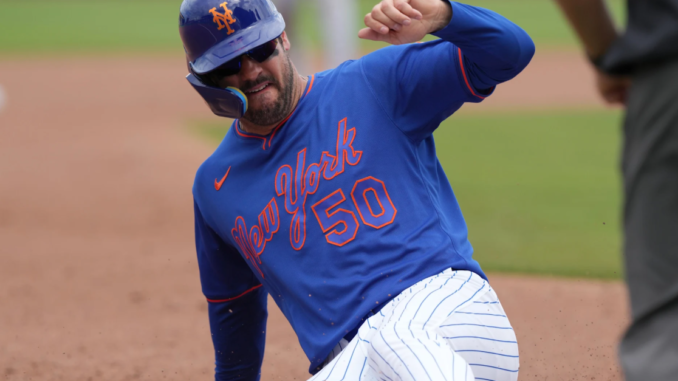
It’s easy with Mike Tauchman, but not so much with the other veteran with an opt out.
Mike Tauchman gave the New York Mets some flexibility by agreeing to a minor league deal that includes an opt-out on March 25, essentially allowing the team time until Opening Day to make a decision.
Based on his performance, the choice seems straightforward. Tauchman is slashing .333/.431/.616, offers the ability to play all three outfield spots — especially well in the corners — and brings strong plate discipline. He fits perfectly as a bench option, even if there are questions about how playing time will be distributed.
With Carson Benge also in the mix, right field could become crowded. However, the Mets can sort that out by giving Luis Robert Jr. regular rest, as planned, while also rotating Benge into center field. Tyrone Taylor would serve as a speed option off the bench.
There’s less urgency for a player like Vidal Brujan, who would likely be surpassed by Brett Baty at most infield spots outside of shortstop. Occasional starts could instead go to Bo Bichette.
Putting together the most effective roster may be complicated, but it’s manageable. That said, the situation becomes more difficult when considering another veteran with an approaching opt-out — Craig Kimbrel, who can opt out on March 21.
The Mets need to decide Craig Kimbrel’s fate by this Saturday
Craig Kimbrel has delivered the kind of results the New York Mets likely hoped to avoid. While his 2.25 ERA looks solid on paper, the underlying performance has been less convincing — four walks in four innings with just two strikeouts, not even factoring in his outing during World Baseball Classic exhibition play.
His numbers tell a mixed story. A 1.50 WHIP raises concerns, even as opponents are hitting just .182 against him. That contrast leaves questions about what he can realistically offer the Mets heading into the season.
Ultimately, the decision on Kimbrel may hinge on whether the Mets want a second left-hander in the bullpen. Bryan Hudson and Richard Lovelady are known quantities. Hudson has struggled this spring in a small sample, making him a potential bounce-back candidate, while Lovelady’s track record suggests limited upside despite his preseason numbers with the Washington Nationals.
From the Mets’ perspective, the ideal outcome would be for Kimbrel to remain in the organization and continue refining his game in Triple-A Syracuse. He spent much of last season in the minors, so it wouldn’t be unprecedented. Still, it’s reasonable to expect he may look for opportunities elsewhere.
If the Mets decide they don’t need a second lefty, Kimbrel could eventually be designated for assignment. That final bullpen spot effectively serves as a replacement for A. J. Minter in name, even if not in role.
With only a couple of appearances left before final roster decisions are made, Kimbrel hasn’t clearly separated himself — but neither have the other options. The Mets could consider waiving Hudson and Lovelady in an attempt to pass them through waivers. In the end, the choice will come down to roster construction, defined roles, and how much confidence the team has in each arm.
Leave a Reply