
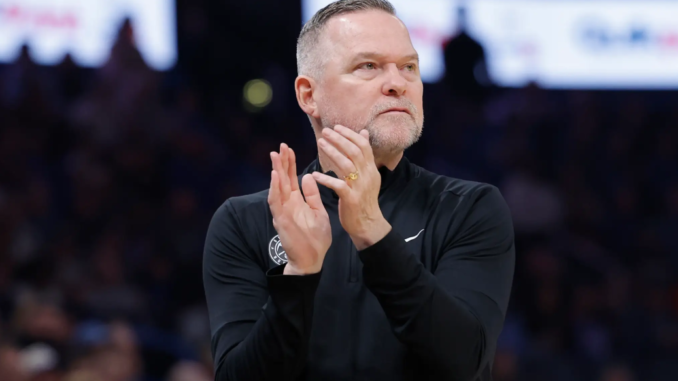
Michael Malone Addresses North Carolina’s Biggest Basketball Weakness
North Carolina entered the offseason needing a significant reset after suffering a first-round NCAA Tournament exit for the second consecutive season.

The Tar Heels were also facing an unusual challenge. Michael Malone was hired as the program’s new head coach just as the transfer portal window was opening, leaving him and his staff with very little time to reshape the roster.
Despite the difficult timing, North Carolina managed to put together an intriguing group of players. One of Malone’s biggest priorities was immediately addressing the backcourt, an area that had been a major concern for the Tar Heels the previous season.
Malone’s Approach
Speaking to reporters Thursday, Malone reflected on the circumstances surrounding his arrival and explained why improving the guard rotation was one of his first priorities.
“When that portal opened the day I got the job, it seems like five months ago, we addressed the backcourt,” Malone said. “We added Terrence Brown, we added Matt Able, we added Neo Avdalas, and I think those three guys combine for one of the more dynamic and exciting backcourts in all of college basketball.”
Malone also praised the work ethic of his new guards and highlighted the flexibility they provide.
“Those guys have all been working very, very hard, and I think our backcourt has size, versatility, and we can go in a lot of different ways with how we use that backcourt,” he added.
Why Fixing the Backcourt Was So Important
North Carolina’s problems last season were particularly noticeable in the backcourt. The Tar Heels struggled to generate consistent production from their guards, with shooting struggles and the absence of a dependable true point guard limiting the offense.
That could look very different this season.
Terrence Brown, Matt Able, and Neoklis Avdalas all bring the ability to create offense in multiple ways, giving Malone several options when designing his lineups and offensive schemes.
There are still areas that need improvement. Brown and Avdalas, for example, will need to become more efficient shooters. Both connected on 33% or less of their three-point attempts in 2025.
Able, meanwhile, showed reliable shooting ability last season in a smaller role coming off the bench at NC State.
Even with those questions, the overall versatility of the trio could make them difficult for opposing defenses to handle. All three players can initiate the offense, bring the ball up the court, or operate away from it.
That interchangeability gives Malone the freedom to use different combinations and offensive actions throughout a game. A position group that represented a glaring weakness for North Carolina a year ago could now become one of the team’s biggest strengths.
A Strong Backcourt Raises the Ceiling
Recent championship-caliber teams have certainly benefited from talented frontcourts, but elite guard play has often been the factor that separates the best teams from the rest.
A team can have plenty of talent inside, but without guards who can create, shoot, handle the ball, and make plays under pressure, its ceiling becomes much lower.
North Carolina may not enter the 2026 season as an obvious national championship favorite, but the revamped backcourt gives the Tar Heels considerably more offensive flexibility and makes them a much more dangerous team.
What was once a glaring weakness could ultimately become one of the biggest reasons North Carolina exceeds expectations this season.
Leave a Reply