
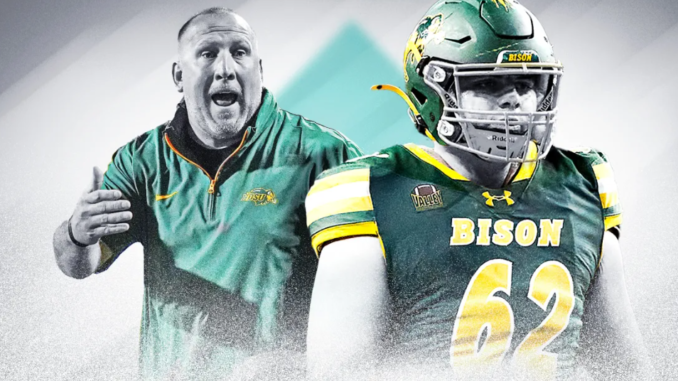
“We Can Play With Anybody”: North Dakota State’s Rise From FCS Powerhouse to the Mountain West
Griffin Empey entered North Dakota State’s Super Bowl Sunday team meeting unsure of what he was about to hear.
Rumors had been spreading throughout campus about a possible move to the FBS. Empey, an FCS All-American guard in 2025, began to wonder if the speculation was real. Walking through Fargo’s bitter winter weather, he allowed himself one hopeful thought: “This actually might be a thing.”
He soon got his answer.
North Dakota State was moving up to the FBS and joining the Mountain West Conference in 2026. The announcement became official on Feb. 9, creating a memorable day for the Bison. While former North Dakota State standout Gray Zabel was helping the Seattle Seahawks win Super Bowl 60, his former school was celebrating its own major milestone.
“Everybody got out of their seats, was jumping around, high-fives, all that stuff,” Empey told The Sporting News. “We’re really excited about it. We feel like we put the work in and can play with anybody and compete with the best because that’s how we train and that’s how we prepare. We’re ready for it.”
Now, the long-awaited transition has arrived.
North Dakota State, which owns a record 10 FCS national championships, is scheduled to make its FBS debut against Jacksonville State at 5:30 p.m. ET Saturday at the Fargodome. The game will be televised by CBS Sports Network. Sacramento State is also beginning its FBS era against Eastern Michigan.
Why the Bison Made the Jump
Even head coach Tim Polasek did not expect the move to happen so quickly.
When Polasek signed a seven-year extension on Nov. 25, 2025, he believed there was only a 1% chance North Dakota State would move to the FBS in 2026. However, athletic director Matt Larsen and university officials were already exploring the possibility, while new university president Marshall Stewart was also part of the school’s leadership transition.
Polasek stayed in Fargo despite a hectic 2025 coaching cycle that created numerous FBS opportunities. His wife, Jill, is from Fargo, and the couple has embraced their identity as “very humble small-town people.”
For Polasek, helping build North Dakota State into a successful FBS program was an opportunity worth taking.
“With North Dakota State – if our legacy is we positioned it to be a really successful FBS school or program, that looks like a lot of fun to us,” Polasek said.
Polasek has deep ties to the Bison. He played quarterback at Division II Concordia in Wisconsin and worked as a logger before Craig Bohl hired him as an assistant coach at North Dakota State in 2006.
He remained with the program in several roles through 2012, witnessing its transformation into an FCS giant. The Bison won five consecutive national championships from 2011-15 and went 71-5 during that stretch.
After a season at Northern Illinois, Polasek returned as North Dakota State’s offensive coordinator from 2014-16. He later coached Iowa’s offensive line from 2017-20 and served as Wyoming’s offensive coordinator from 2021-22.
He became North Dakota State’s head coach in 2023. By then, the Bison had added national championships in 2017, 2018, 2019 and 2021 under Chris Klieman and Matt Entz.
Polasek eventually guided North Dakota State to its 10th title, defeating Montana State 35-32 in the 2024 FCS championship.
He believes the move to the Mountain West has brought back the excitement surrounding the program’s early championship years.
“It spans 20 years, and this is my third time back here,” Polasek said. “Right now, it feels closer to 2011 and 2012.”
From FCS Dominance to a National Brand
North Dakota State has already shown it can challenge FBS teams. Since 2004, the Bison are 9-5 against FBS opponents, including a 23-21 upset of No. 13 Iowa in 2016.
Polasek joined Iowa’s coaching staff the following season and gained a different perspective on North Dakota State’s reputation.
He already knew the Bison were a major force across the Upper Midwest, but his time at Iowa convinced him the program had developed a national following.
“I knew NDSU was a big deal regionally, Minnesota, Wisconsin, South Dakota,” Polasek said. “It wasn’t until I was at Iowa and I was on the other side of it … that I started noticing a lot of hats and sweatshirts and those kinds of things at airports. I do think that we have a national brand.”
That dominance also created a problem: expectations became extremely high. Fans became accustomed to postseason success, and some regular-season Missouri Valley Football Conference games struggled to generate the same excitement.
The Mountain West provides a solution by giving North Dakota State a new level of competition.
The move is not without risk. The Bison are one of only four FCS programs with at least three national championships, joining Georgia Southern, Youngstown State and Appalachian State.
Appalachian State went 105-49 after moving to the FBS in 2014, while Georgia Southern has posted an 80-72 record since making the same move. James Madison, which transitioned in 2022, is 40-11 and has already reached the College Football Playoff.
Still, Polasek expects North Dakota State’s adjustment to take time.
“I’m not saying we’re playing catch up, but it’s good for people to know that we weren’t able to recruit the portal at the FBS level,” he said. “We weren’t able to recruit the 2027 class at the FBS level.”
What North Dakota State Brings
The excitement around Fargo has already been obvious.
At Fan Day on Aug. 18, Empey noticed how eager supporters were to discuss the upcoming season.
“Fargo is excited. The university is excited,” he said.
The Bison bring a strong developmental tradition to the Mountain West, particularly along the offensive line. Empey is part of the position group known as the “Ram,” which has produced four NFL draft picks since 2021: Gray Zabel, Cody Mauch, Cordell Volson and Dillon Radunz.
Polasek believes North Dakota State’s player-development system can continue producing NFL-caliber talent.
“The pedigree there is a little bit unrivaled,” he said. “When you look at our development plan, and how we’ve done it here, we’re no slouch.”
The Bison also have a strong quarterback history, producing Carson Wentz, Easton Stick, Trey Lance and Cam Miller. Cole Payton is another recent name in the program, while Nathan Hayes is expected to take over in 2026.
Then there is the Fargodome.
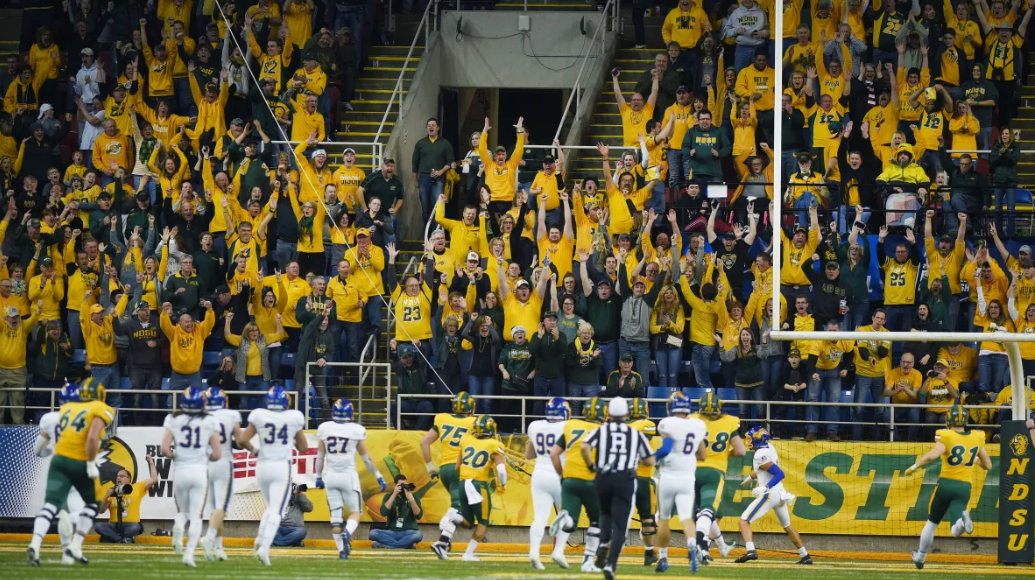
The 19,000-seat indoor stadium has been one of North Dakota State’s biggest advantages. The Bison have won 85.7% of their games there since 1993.
Empey believes the atmosphere begins long before kickoff. Fargo’s tailgating culture remains a major part of game day, even when temperatures fall into the single digits.
“People will be out there five or six hours before kickoff,” Empey said. “People are 25 deep at their tailgate.”
He expects the noise inside the Fargodome to give visiting teams a taste of what makes North Dakota State special.
Learning From Boise State
Boise State provides perhaps the clearest blueprint for what North Dakota State could become.
The Broncos won an FCS championship in 1980 before moving to Division I football in 1996. Their rise eventually turned them into a national brand, highlighted by blue turf, creative offense and major upset victories.
Boise State reached the College Football Playoff in 2024 and moved to the Pac-12 in 2026.
Polasek sees similarities between the two programs and believes North Dakota State’s move could benefit Fargo and the entire state.
“We’re going to work hard to get the whole state attached to this thing,” he said.
North Dakota State enters the Mountain West with an established identity based on physical, disciplined football. Polasek’s philosophy is simple: “Good, clean, tough football is the No. 1 thing that can keep you in every game.”
Other FCS programs, including Sam Houston, Jacksonville State, Kennesaw State, Delaware and Missouri State, have also moved up recently, and each has already reached a bowl game.
But North Dakota State arrives with something those programs did not have: an unprecedented FCS résumé.
Now the Bison must prove their success can translate to the FBS.
“There have been an awful lot of people who felt like we could play at this level, and so it’s here now,” Polasek said.
The belief is already there. The next step is proving it on the field.
“We’re not going anywhere. We’re in the Mountain West,” Polasek said. “We’ve got to prove … that we belong.”
Leave a Reply