
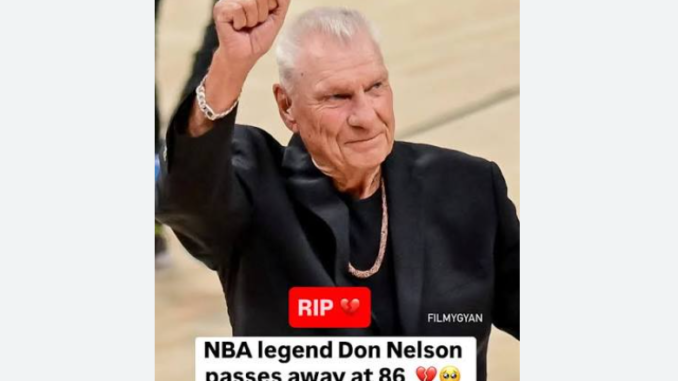
A former Knicks coach passed away. Plus, some updates on the Knicks’ second rounders, and we say hi to No. 63 on the Knicks 100.
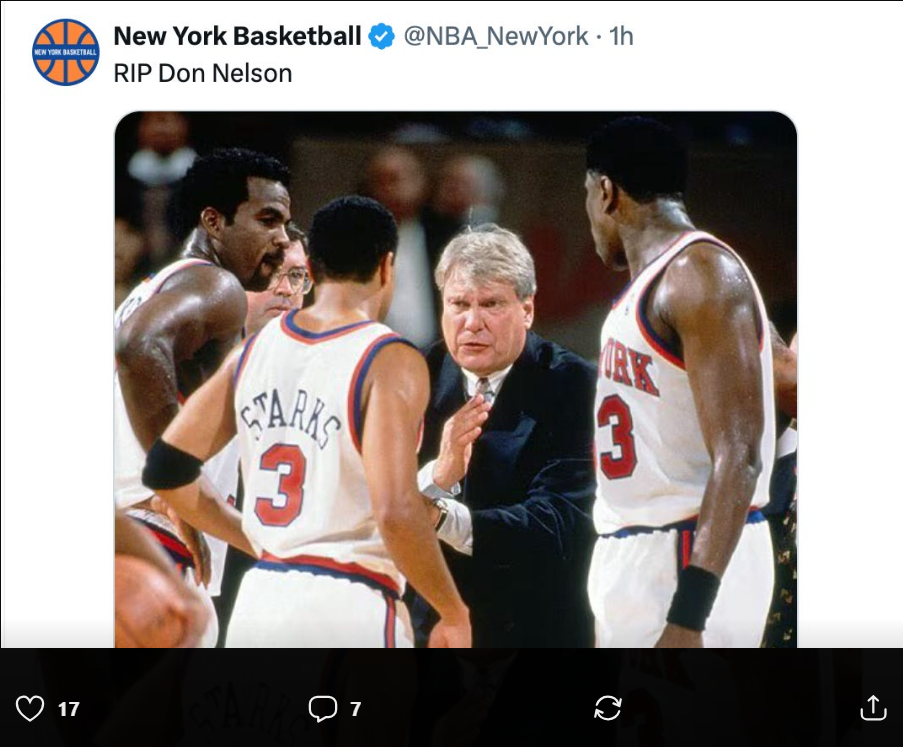
Good Morning! Before we get to today’s entrant onto the Knicks 100, we have a few pieces of news…
Rest in peace, Don Nelson.* Nelson’s brief run as head coach of the New York Knicks wasn’t particularly successful, but that period doesn’t overshadow what was an exceptional coaching career. Before becoming one of the NBA’s most respected coaches, Nelson enjoyed a strong playing career with the Boston Celtics. He was also one of the most memorable personalities the league has ever produced, and his reputation seemed to grow even more as the years passed. He will be greatly missed.*
Goodbye Jack Kayil — for now — but Tyler Nickel could still return.* Kayil, selected 39th overall in the draft, has announced that he will remain in Europe after signing a new five-year contract. The agreement is presumably structured with a reasonable buyout in case an NBA opportunity comes his way down the road. Nickel, who was taken 47th overall, has yet to make a final decision on whether he will return to college. However, reports indicate that Nickel is fully committed to beginning his professional career. The Knicks have also issued qualifying offers to both Kayil and Nickel, allowing the organization to retain their draft rights.*
The Knicks now have three confirmed preseason games on their schedule.* New York will begin preseason play on Thursday, October 8, against the Washington Wizards. The Knicks will then travel to Toronto to face the Raptors on Tuesday, October 13, before hosting Toronto at home on Thursday, October 15.*
Before getting to No. 63 on the Knicks 100, here’s a quick recap of the players from the Leon Rose era who have already made the list. So far, No. 100 Alec Burks, No. 85 Jordan Clarkson, No. 81 Jose Alvarado, No. 74 Derrick Rose, and No. 70 Isaiah Hartenstein have all been featured. That brings us to…
The Knicks 100: No. 63 – Immanuel Quickley
It’s easy to forget that during Jalen Brunson’s first season with the Knicks — a campaign in which New York finally won a playoff series for the first time in 10 years and Brunson began to emerge as a potential franchise cornerstone — one of the most unforgettable games of the season came with Brunson sitting on the bench.
Brunson was sidelined with an injury he had suffered two nights earlier in Miami, while the Knicks entered the matchup riding an eight-game winning streak. Waiting for them were the 45-19 Boston Celtics, who were looking for payback after New York had defeated them at Madison Square Garden the previous week. In that earlier meeting, Immanuel Quickley had already made his presence felt, leading the Knicks with 23 points off the bench and strengthening his case as a leading candidate for Sixth Man of the Year.
As it turned out, Quickley was only getting started.
Quickley played 55 of a possible 58 minutes that night — a workload that, remarkably, has not been matched by another NBA player since. He put on a show against Boston, finishing with 38 points, eight rebounds, seven assists, four steals, and two blocks. It was the kind of performance that made it clear Quickley believed he had a significant role to play in the future of the young Knicks core.
In a way, he was absolutely right. It just didn’t unfold the way many expected.
Less than a year later, Quickley had become the starting point guard for the Toronto Raptors. He was the centerpiece of a trade that also sent RJ Barrett back to his native Canada while bringing OG Anunoby to New York. Then, that summer, Quickley secured a lucrative new contract that made him one of the NBA’s highest-paid point guards. In fact, he earned $7.5 million more during the first season of that deal than Brunson, the player he had once backed up in New York.
On paper, Quickley had finally achieved much of what he had been working toward. He had a starting role, a major contract, and the freedom to shape his own career without having to operate in someone else’s shadow.
The question is whether the journey ultimately turned out to be worth it.
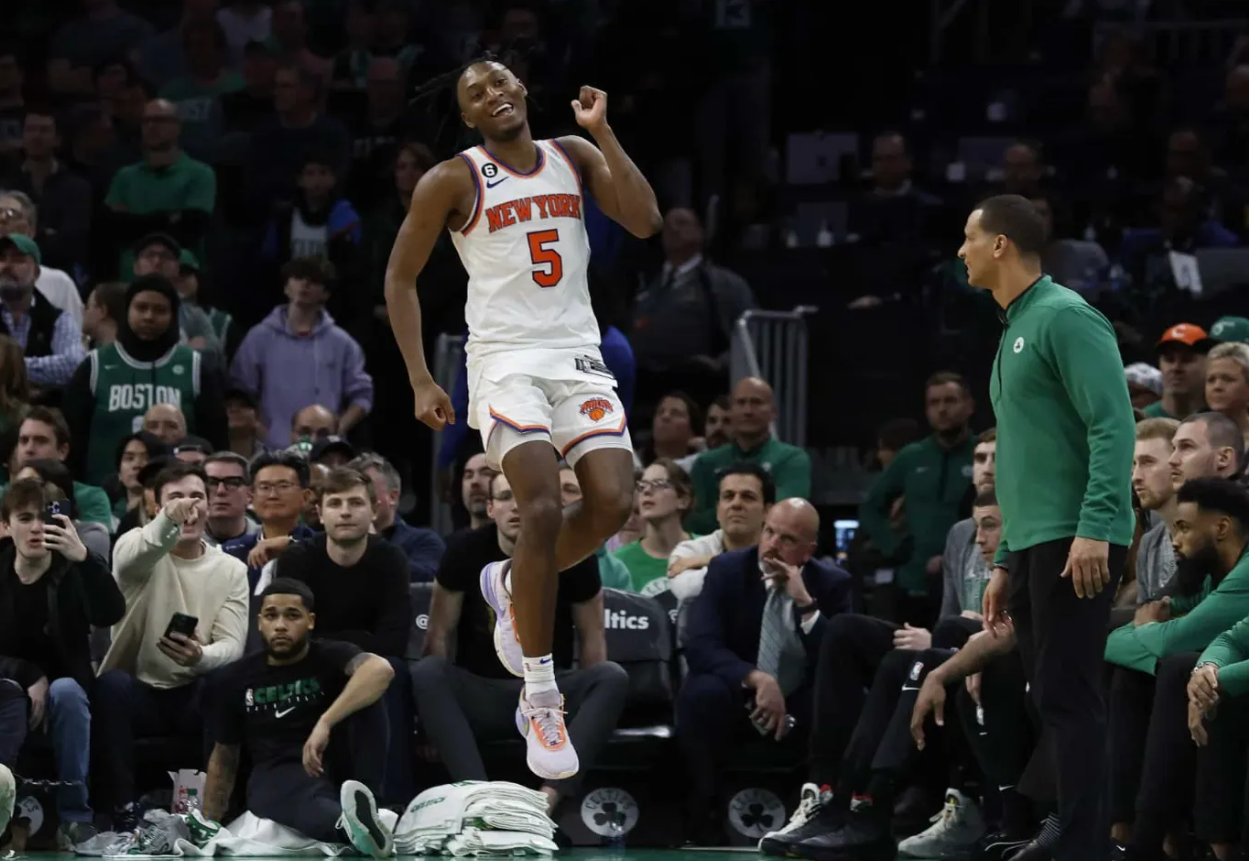
Among the biggest “what if” scenarios of the past five years, Immanuel Quickley’s situation is one of the first that comes to mind.
The biggest question is what might have happened if Quickley had accepted the contract extension the Knicks were reportedly prepared to offer him.
At the time, reports indicated that New York wanted to keep Quickley long-term, with his market value believed to be somewhere between $16 million and $20 million per year. The Knicks appeared willing to reach that range, and Quickley seemed genuinely happy playing in New York.
Instead, the Knicks ultimately used him as part of the package to acquire OG Anunoby. Anunoby will appear much higher on this list despite playing nearly 100 fewer regular-season games for New York than Quickley did. That raises another interesting question: Could the Knicks have acquired Anunoby without including Quickley? If so, perhaps they would have needed to surrender additional draft capital, which could have prevented the eventual Mikal Bridges trade.
In that alternate scenario, maybe Quickley eventually develops into the Knicks’ starting shooting guard, potentially under a different head coach. Or perhaps he still becomes the salary piece in a deal for Bridges, meaning Knicks fans would now be watching him establish himself across the East River.
Quickley’s decision to bet on himself became one of the biggest turning points of the Jalen Brunson era, aside from Brunson himself choosing New York. The frustrating part for Quickley is that his departure didn’t remain a major talking point for long. Within roughly 72 hours, Knicks fans had gotten a glimpse of how perfectly Anunoby fit into the lineup and how dangerous this new version of the team could become.
That doesn’t diminish Quickley’s importance to the larger story, though. His Knicks résumé is packed with performances that made fans stop and appreciate what they were witnessing. There was something special about watching him develop in real time and seeing the confidence of a potential star emerge right in front of everyone.
The Boston game may have been Quickley’s signature performance, but it was far from his only memorable showing. He produced enough exciting moments during his time in New York to fill an entire museum wing. There was simply something different about an “Immanuel Quickley Game.”
So, is No. 63 the appropriate spot for him on this list? If we’re judging purely by the feeling he gave Knicks fans, some could make a case for him being among the top 50. On the other hand, his lack of significant playoff moments could justify placing him closer to No. 75 or even lower.
I decided to split the difference and place Quickley just below two other scoring guards who will forever be closely connected:

As I mentioned in a previous newsletter, Nate Robinson and Jeremy Lin are two of the three players on this list who never reached the playoffs or earned an All-Star appearance as members of the Knicks. Jamal Crawford is the third.
It’s interesting to look back at the difficult period between 2004 and 2008, when New York averaged just 28 wins over four seasons before Donnie Walsh arrived and began positioning the franchise for its pursuit of LeBron James. Crawford was one of the few bright spots during that stretch. Even in those rough years, Knicks fans viewed him as someone who might eventually be part of the team’s turnaround. That made Walsh’s decision to move Crawford’s contract for salary relief just 11 games into the Mike D’Antoni era particularly notable. Crawford was coming off what was arguably the best season of his career, averaging an efficient 20 points per game for a Knicks team that was one game above .500 when he was traded.
After leaving New York, Crawford went on to build a remarkable career as one of the NBA’s premier sixth men. He won the first of his three Sixth Man of the Year awards during his first season away from the Knicks and eventually reached the second round of the playoffs four times. His scoring ability simply never had the same positive effect in New York because the franchise was dealing with so much instability around him. Even so, Crawford remains one of only two players from the post-Patrick Ewing, pre-Carmelo Anthony era to rank inside the top 30 in franchise scoring. He currently sits 29th.
The other player is Stephon Marbury, who comes in at No. 30.
Could Marbury deserve to rank ahead of Crawford? In almost every statistical category outside of scoring, the argument can certainly be made. Marbury was a more efficient scorer, a better passer, and accumulated significantly more win shares, ranking 28th in Knicks history compared with Crawford at 49th. He also led a Knicks team into the playoffs, something relatively few players from that era can claim, even though the 2004 first-round matchup with New Jersey ended in a disappointing sweep.
Despite that, Marbury remains a polarizing figure among Knicks fans. Recent criticism of him during the playoffs sparked another round of debate, and it wasn’t an isolated opinion. A sizable portion of the fan base still associates Marbury with more frustration than positive memories, despite the Hall of Fame-caliber career he later put together overseas. I’ve said it before, and I’ll say it again: given the condition of the Knicks franchise during much of Marbury’s tenure, no individual player could have realistically rescued the team. Stephon certainly didn’t always make things easier, but he was hardly the root of New York’s problems. That’s why I have him ranked just ahead of both Quickley and Crawford.
Next up, we return to the 2026 Knicks and look at a player whose reputation skyrocketed throughout this latest playoff run.
Leave a Reply